The Best AI Medical Scribes in 2026
Twelve ambient clinical documentation tools compared on real pricing, EHR integration, and BAA coverage - including which ones a solo clinician can buy.
Written by Dictation Database Team
The ambient AI scribe market has split cleanly in two. On one side are tools a single clinician can sign up for with a credit card in five minutes. On the other are enterprise platforms sold to health systems through a three-to-six-month procurement process, with pricing that only appears after a demo.
Which half you're shopping in determines everything, so start there.
Short answer: Freed is the best option for an individual clinician at $39–119 a month. Heidi Health is the best free starting point. Abridge has been Best in KLAS two years running but sells only to health systems. Dragon Medical One remains the incumbent if you need dictation rather than ambient scribing.
What you can actually buy today
| Tool | Self-serve? | Price | Platforms |
|---|---|---|---|
| Freed | Yes, 7-day trial no card | $39–119/mo | Web, iOS, Android |
| Heidi Health | Yes, free tier | Free; ~$150/user/mo | Web, iOS, Android |
| Nabla | Moved to demo/contract sales in 2026 | Free tier; ~$119–239/mo | Web, iOS, Android |
| Dragon Medical One | Via reseller | ~$79–99/user/mo + ~$525 setup | Windows, web |
| Suki | Quote only | ~$299–399/user/mo reported | Web, iOS, Android |
| DeepScribe | Enterprise sales only | ~$350–500+/provider/mo reported | Web, iOS |
| Abridge | Health system procurement | ~$150–300/clinician/mo reported | Via health system |
| Augmedix | Enterprise sales | Not published | Web |
| INVOX Medical | Demo only | Not published | Any device |
Pricing for the enterprise tier is reported rather than published - none of these vendors post a price list. Treat the figures as a starting point for negotiation, not a quote.
Best for an individual clinician: Freed
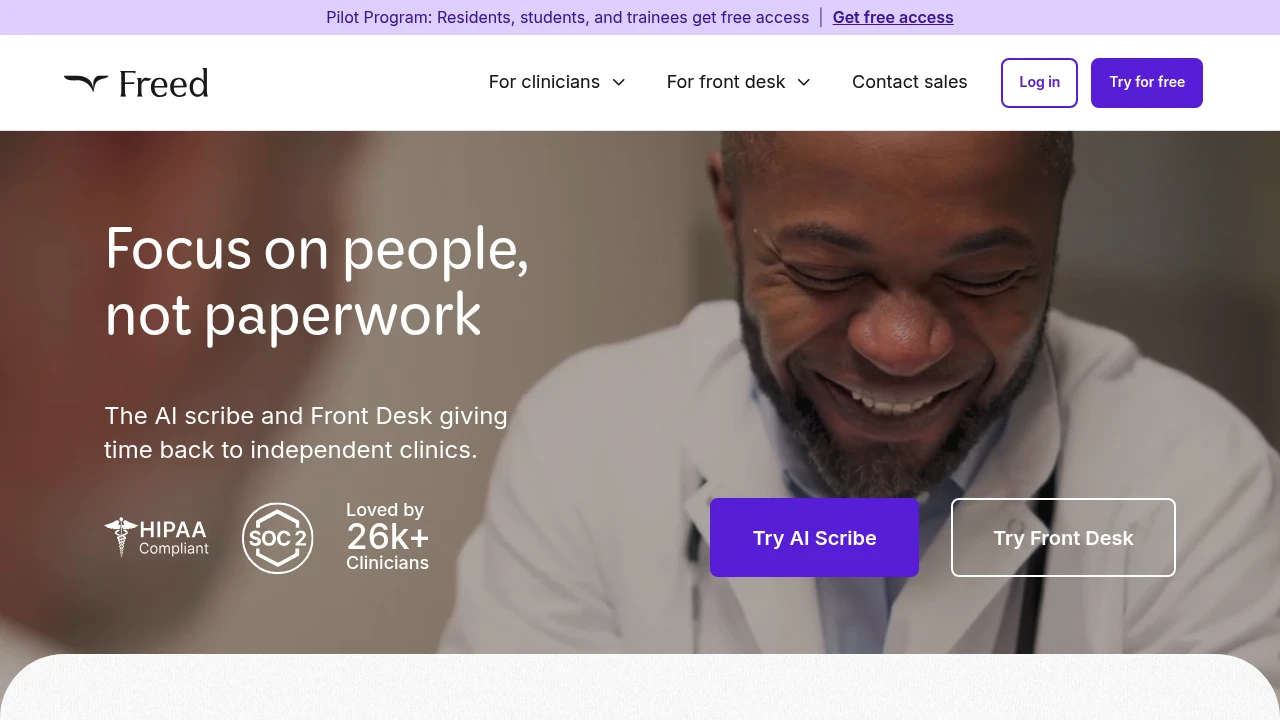
Freed is the tool that solved the access problem. Seven-day trial, no credit card, roughly five minutes to set up, and pricing that a solo practitioner can absorb: $39 a month for 40 notes, $79 for unlimited notes plus an AI editing assistant, $119 for Premier - which drops to around $90–104 on annual billing. Over 26,000 clinicians use it.
It's HIPAA-compliant with a BAA, runs on web, iOS, and Android, and doesn't require an EHR integration project to be useful. You get a note; you paste it where it needs to go.
What you don't get is deep EHR integration. If your requirement is bidirectional Epic sync, this is the wrong tier of product.
Best free option: Heidi Health
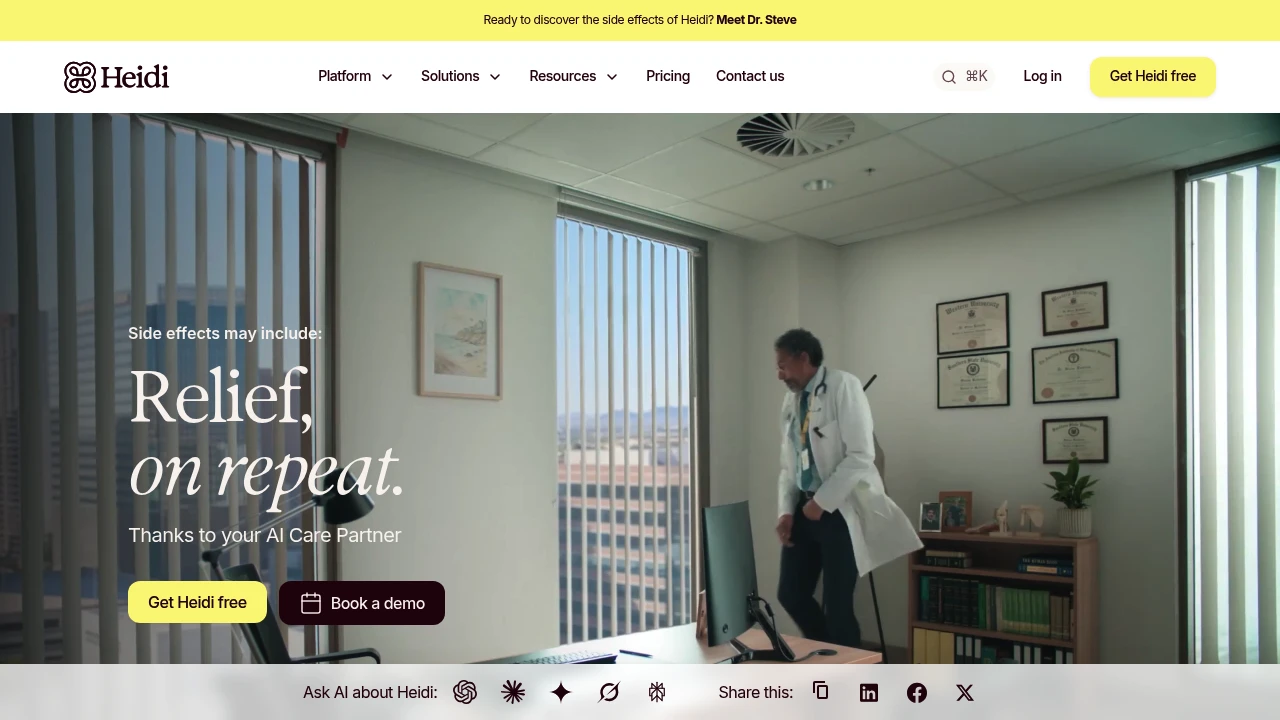
Heidi Health has the most generous free tier in clinical documentation: unlimited basic consults and dictation, with ten "Pro Actions" a month metered on top. Paid tiers are reported at around $150 per user per month billed yearly for Clinician, or around $99 per user per month for Practice with EHR integrations, plus an Evidence Plus add-on around $40 a month for BMJ and NICE guidelines.
Confirm BAA coverage on whichever plan you land on before you use it with real patient data. Free tiers and BAAs do not always come together in this category - see the warning below.
The free tier warning
Nabla offers a free tier at a reported 30 consultations a month, and it reportedly comes without a BAA. Without a signed Business Associate Agreement, using a tool with protected health information is a HIPAA problem regardless of how secure the vendor's infrastructure is.
Nabla's paid plans - reported around $119 a month for Starter and $239 for Pro - are HIPAA-compliant, and the company moved to demo and contract sales during 2026.
The general rule: "HIPAA-compliant" describes the vendor's capability. A BAA is the contract that makes it your legal protection. Ask which plans the BAA covers, in writing, before uploading anything.
The enterprise tier
If you're buying for a health system, the shortlist is different and the timelines are longer.
Abridge has won Best in KLAS for Ambient AI in both 2025 and 2026, integrates deeply with Epic and Cerner, and is deployed at 250+ health systems. Pricing is quote-only, reported around $2,500 per clinician per year - roughly $208 a month - with a wider reported range of $150–300 per clinician per month depending on deal size, and some sources citing $400–600. System-scale contracts run $50,000 to $500,000+ annually, with three to six months to deploy.
Suki is the one to look at if you want the assistant to read the chart as well as write to it. Bidirectional, real-time integration with Epic, Oracle Cerner, athenahealth, and MEDITECH, across 100+ specialties. Suki Compose is reported from $299 per user per month, Suki Assistant from $399.
DeepScribe is reported at $350–500+ per provider per month, with a base non-EHR-integrated tier around $350, setup fees of $500–1,000, and mandatory annual contracts. Two things to weigh: notes arrive hours after the encounter rather than in real time, and there's no Android app.
Augmedix has been a wholly-owned subsidiary of Commure since October 2024, acquired for around $139M. It combines AI automation with human review and is deployed at 20+ major health systems. Check what you're actually buying and under which brand.
INVOX Medical is the outlier: it can be deployed on your own servers rather than the vendor's cloud, and it's Spanish-first, with support for Portuguese, Brazilian Portuguese, Catalan, Euskera, and Galician. Three products - Invox Dictation for real-time, Invox Genesis for ambient structured notes, Invox Aura for ward rounds - with APIs, SDKs, Open EHR, and HL7 integration. Fifteen years in clinical voice recognition.
Ambient scribing vs dictation
These are different products and the distinction gets blurred in marketing.
Dictation means you speak the note. You control the content, you say "period" and "new paragraph," and the software types it. Dragon Medical One is the standard here: roughly $99 per user per month on a one-year term, $89 on two years, $79 on three, plus about $525 one-time implementation per new user, bought through Microsoft healthcare sales or a certified reseller.
Ambient scribing means the software listens to the patient encounter and writes the note itself. You review and sign. That's Freed, Abridge, Suki, Nabla, Heidi Health, and Nuance's own Dragon Copilot, which resellers price from around $160 per user per month on a twelve-month term.
Ambient scribing saves more time when it works. Dictation is more predictable and puts you in control of what ends up in the chart. Plenty of clinicians use both.
Legal dictation
Adjacent market, similar structure. BigHand treats legal dictation as workflow software - routing, delegation, turnaround tracking - at a reported $3,000–4,000 per attorney per year for a full deployment, with a BigHand Professional per-user annual subscription aimed at smaller firms. Its Spring Update '26 added AI email routing.
Philips SpeechLive is the cheaper entry point at $12.90 per user per month for Basic, $17.90 for Pro, $21.90 for Enterprise - with speech recognition itself as a $25.90 add-on, which roughly triples the Basic price. Read the line items.
Dragon Legal remains part of the active Dragon line.
Questions to ask any vendor
- Does the BAA cover the specific plan I'm buying? Get it in writing.
- Is patient audio or text used to train models? And can that be turned off on my tier?
- What's the retention period, and can I set it?
- How long until a signed note? DeepScribe delivers hours later; others are near-real-time.
- What does EHR integration cost and how long does it take? Setup fees of $500–1,000 are common, and health-system deployments run three to six months.
- What's the contract term? Mandatory annual contracts are the norm above the self-serve tier.
- Who owns the vendor now? Augmedix is Commure; Nuance is Microsoft. Consolidation is constant.
Frequently asked questions
What is the best AI medical scribe?
For an individual clinician, Freed at $39–119 a month. For a health system, Abridge, which has been Best in KLAS two years running. For dictation rather than ambient scribing, Dragon Medical One.
Is there a free AI medical scribe?
Heidi Health offers unlimited basic consults free with ten Pro Actions a month. Nabla has a free tier at a reported 30 consultations a month, but it reportedly comes without a BAA, which makes it unsuitable for real patient data.
How much does an AI medical scribe cost?
$39–119 a month for self-serve tools like Freed, around $79–99 a month for Dragon Medical One plus setup, and $150–500 per clinician per month for enterprise platforms like Abridge, Suki, and DeepScribe.
Do AI scribes integrate with Epic?
Abridge has deep Epic and Cerner integration, and Suki is bidirectional and real-time with Epic, Oracle Cerner, athenahealth, and MEDITECH. Self-serve tools like Freed generally don't - you copy the note across.
Is Dragon Medical One still the standard?
For clinical dictation, largely yes, and it's where Nuance's attention went as the consumer Dragon line was wound down. For ambient scribing, the newer entrants have taken the lead, and Nuance's own answer is Dragon Copilot.
Last verified: 10 August 2026.