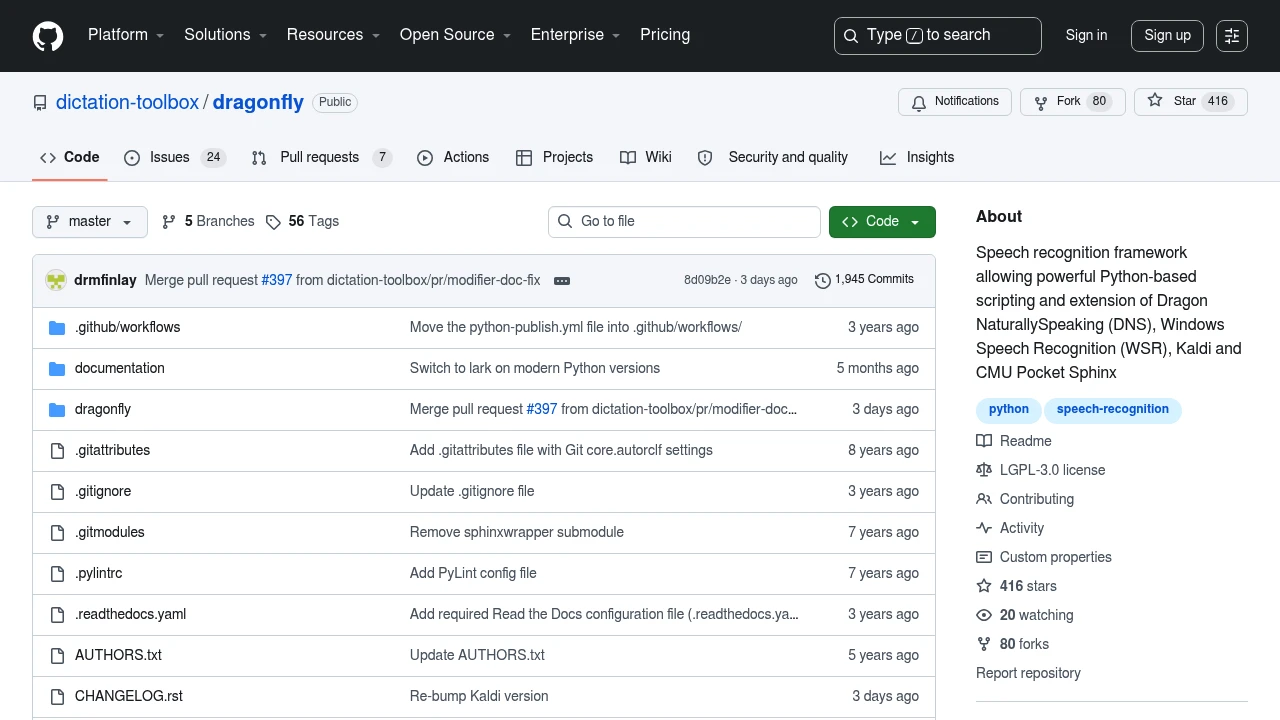
LGPL Python framework for writing custom speech recognition grammars, with a single API across Dragon, Windows Speech Recognition, Kaldi, and Pocket Sphinx.
Dragonfly is infrastructure rather than an application. It's a Python framework for defining voice commands and grammars, and its central value is abstraction: you write a command once and it runs against Dragon NaturallySpeaking, Windows Speech Recognition, Kaldi, or CMU Pocket Sphinx without rewriting. Caster is built on it. If you're constructing your own voice control system on Windows or Linux, this is the layer you start from.
At a glance
Licence
LGPL-3.0
Platforms
Windows, macOS, Linux (X11 only — Wayland not fully supported)
Engines
Dragon NaturallySpeaking, Windows Speech Recognition, Kaldi, CMU Pocket Sphinx
One grammar, four engines. Write commands against Dragonfly's API and swap the recognition engine underneath — commercial Dragon for accuracy, or open-source Kaldi to avoid a licence. Nothing else offers that portability.
It's Python. Real programming for command definitions, not a configuration DSL with a ceiling.
Open-source engines supported. Kaldi and Pocket Sphinx mean a completely free, offline, open stack.
LGPL is permissive for a framework. You can build proprietary tools on it without the copyleft reaching your code.
Actively maintained fork.dragonfly2 is the living version, with nearly 2,000 commits and current documentation.
Where it falls short
It's a framework, not a product. By itself it does nothing. You either write all your own grammars or install something like Caster on top. Anyone expecting to install and dictate will be disappointed.
Wayland isn't fully supported. Linux support is X11-only in practice, the same limitation as Talon and nerd-dictation.
The best engine is a declining product. Dragon NaturallySpeaking gives the strongest accuracy, but Nuance has wound down most of that line. Kaldi is the sustainable choice and is less accurate.
The fork history is confusing. The original project, the dragonfly2 fork, and the PyPI naming trip people up regularly.
Small community relative to Talon. 416 stars against Talon's much larger ecosystem. Fewer shared configurations to borrow from.
Pricing
Free, LGPL-3.0. Engines are separate: Kaldi, Pocket Sphinx, and Windows Speech Recognition cost nothing; Dragon NaturallySpeaking is a commercial licence.
Who it's for
Developers building their own voice control system who want engine independence and are comfortable writing Python. If you want a working setup rather than a toolkit, install Caster, which is built on this. If you're starting from scratch in 2026 and don't need Dragon compatibility specifically, Talon is the more active ecosystem.
Last verified: 10 August 2026.
Similar to Dragonfly
Dragonfly: The Python layer that lets one grammar drive four different engines – Dictation Database
A ready-made command set for Dragonfly, covering 13+ languages
Voice Coding
Free voice programming toolkit built on Dragonfly with prebuilt commands for 13+ languages and major IDEs. Needs Dragon, Kaldi, or Windows Speech Recognition.